The best golf simulator booking software for indoor golf venues is a platform built specifically for bay-based scheduling, automated access control, membership management, and integrated payments. Eight platforms lead the market in 2026: Golf O'Clock, Alba, Birrdi, USchedule, GolfBooking, AllBooked by Skedda, Sports Carnival, and Trackman. This comparison covers all eight with real pricing, feature breakdowns, and an honest look at what each one does well and where it falls short.
The information in this comparison was gathered from vendor websites, published reviews, online discussion forums, and our own platform data. Competitor pricing, features, and capabilities reflect publicly available information as of May 2026. We encourage you to verify current details directly with each vendor. If anything is inaccurate, contact us and we will update it promptly.
i.A booking system sounds simple on the surface. Time slots in bays. How hard can it be? If you have run a simulator venue for more than a few months, you already know the answer. The edge cases that seemed niche three years ago are now the way most facilities operate. Unmanned venues running around the clock. Places with full kitchens and liquor licenses. Membership-only clubs. Hybrid operations staffed until 6 PM and self-serve after. Chains that need one dashboard across five cities. The indoor golf market has grown fast. The National Golf Foundation estimates over 19 million Americans now play golf off-course. The tools have not kept up.
ii.Most operators are past pen and paper. But a lot of them are working around their golf simulator management software rather than working with it. The system doesn't do what they need, so they build workarounds. Manual access codes texted to customers. Membership tracking in a spreadsheet. A pricing model that only sort of works because the platform can't handle the real one. Here is what is worth saying upfront: the best golf simulator software options on the market right now are, broadly, all decent. Most of them will work. The question is which one works for you.
iii.This is a golf simulator software comparison of the eight platforms that come up most often in the indoor golf space. We built one of them. We aren't pretending to be neutral, but we're being honest about what each one does well and where it falls short.
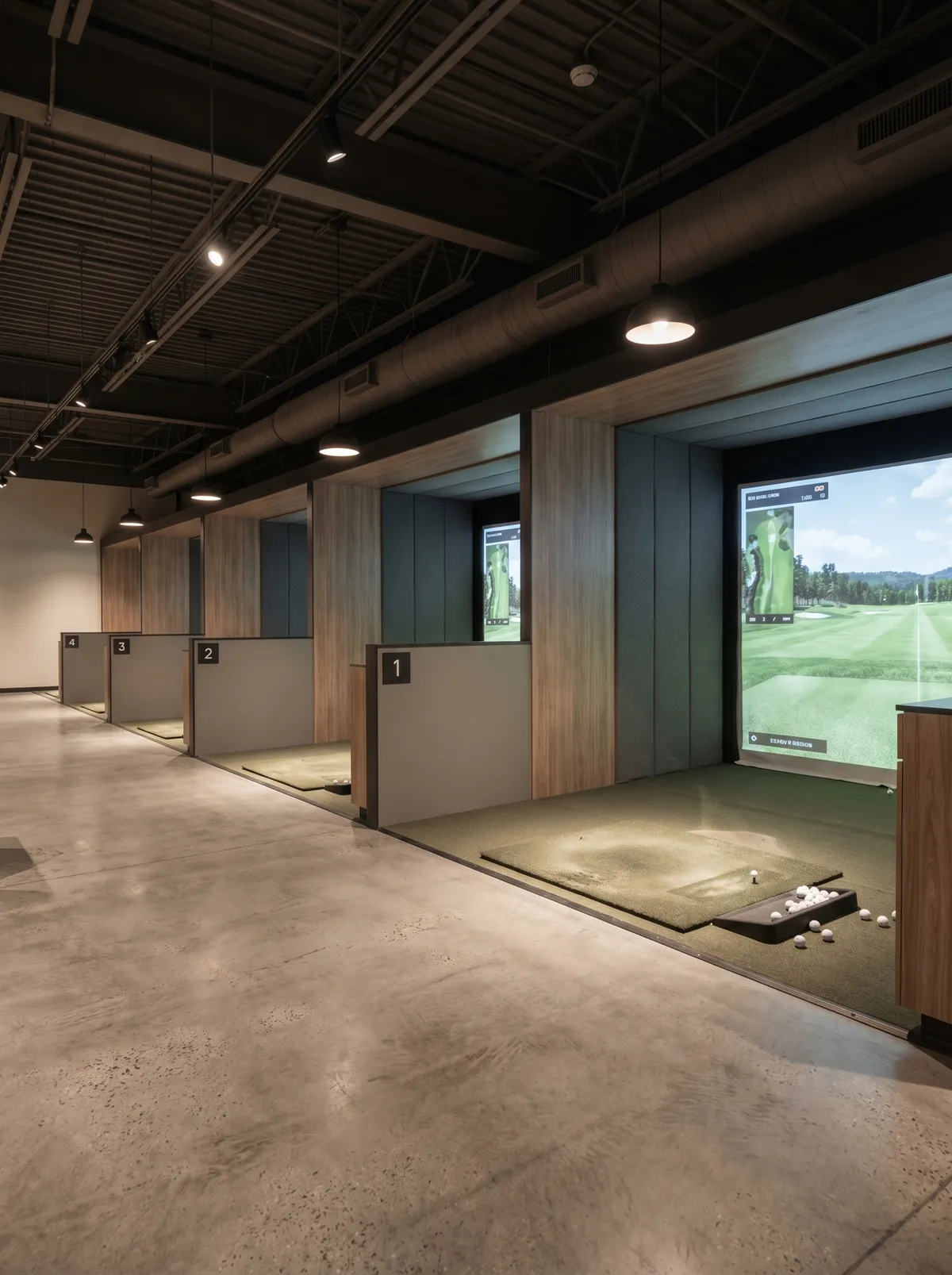
What to look for in golf simulator booking software
Most booking software was built for appointment-based businesses. Indoor golf scheduling software needs to work differently, and the gaps show up fast.
Bays, not appointments. You are selling time in bays, not scheduling appointments. The platform needs to handle multiple bays simultaneously, enforce session lengths, block time for cleaning or coaching, and manage overlapping bookings without someone manually adjusting the calendar every morning. Across the 200+ venues on our platform, the average booking is just under 2 hours with a party size that shrinks from 3+ on the first visit to under 2 by the third. The software needs to handle all of those patterns without configuration gymnastics.
Access control. For unmanned and hybrid venues, the booking system is the access system. A customer books 7 PM, gets a PIN in their confirmation, and that PIN works until 8:01. No staff involved. If this step requires a human, the model breaks at scale. The platform needs to talk directly to the lock hardware: RemoteLock, Kisi, Avigilon, or a proprietary solution. Worth separating two things operators conflate here: true no-shows run about 1%, while about 18% of bookings get cancelled. A card hold at booking moves the second number, from roughly 20% down to 15% when payment is taken up front.
Worth pushing on whether that connection is native or bolted on. Native means the booking system and the access system share the same data in real time. Bolted on usually means a third-party connector syncing on a schedule, which adds latency and one more thing that can break at 11 PM with a customer standing outside the door. One question settles it: when a booking is confirmed, how fast is the access credential generated and sent to the customer? If the answer involves manual steps, or is measured in hours rather than seconds, the integration is not fit for purpose.
Payments without friction. Book, pay (full, partial, or deposit), confirm. No phone call, no manual entry. Reminders before the session and follow-ups after should come from the same system. The average booking on our platform generates $120 in revenue. Every manual step in the payment flow is friction between the customer and that $120.
Memberships that run themselves. Recurring memberships are one of the most reliable revenue structures in indoor golf. They only work if the software automates the billing cycle. Block passes, seasonal packages, member pricing tiers, automatic renewals. If someone on your team is processing membership charges manually each month, that isn't a membership program. That's a chore.
Customer self-service. Every booking question a customer can answer for themselves is one your staff never touches. A real customer portal covers rebooking, cancellation, booking history, membership management, and retrieving access credentials, with nobody on your side involved. For unmanned venues this is not a convenience feature, because there is no one on site to field the question in the first place. Staffed venues get the same benefit pointed the other way: front desk time moves off admin and into the room.
POS integration. If your venue sells food, drinks, or merch, the golf simulator reservation software needs to connect to your point of sale. Stripe, Square, and Lightspeed are the most common in the space. Check whether the integration is native or requires a third-party connector with its own monthly bill.
Reporting. Bay utilization, peak hour patterns, no-show rates, member activity, revenue per session. These are the numbers that drive the weekly operating review. If they live in a CSV you have to export and open in a spreadsheet, you're making decisions slower than you need to.
The best golf simulator booking software compared
| Software | Best For | Pricing | Access Control | POS | Memberships |
|---|---|---|---|---|---|
| Golf O'Clock | All venue types and sizes | From $150/mo (4 bays) + $25/bay | RemoteLock, Kisi, Avigilon, SmartLock | Stripe, Square, Lightspeed | Full |
| Alba | European venues, SimLock users | From EUR 29/resource/mo | Kisi, Zesec | Limited | Limited |
| Birrdi | New US operators, small venues | $0.25-0.75/reservation + $1,000 setup | RemoteLock | Square only | Limited |
| USchedule | Enterprise chains, franchises | Contact for pricing | Limited | Limited | Yes |
| GolfBooking | Budget single-location venues | ~$50/bay/mo | Not native | Limited | Basic |
| AllBooked (Skedda) | Multi-use spaces | From $99/mo | Third-party | Limited | Basic |
| Sports Carnival | Multi-sport complexes | Contact for pricing | Limited | Limited | Limited |
| Trackman | Trackman-native facilities | Contact for pricing | Not native | Not native | Limited |
Golf O'Clock
This is ours, so take the positioning for what it is. Golf O'Clock was built by someone working inside an indoor golf facility who needed a booking system and could not find one that fit. The platform started with one venue in Quebec. Four years later it runs across 200+ active venues, from 3-bay unmanned studios to 20+ bay multi-location operations with full F&B. Over 1.3 million bookings processed, more than $70 million in revenue through the platform, more than 250,000 unique golfers served.
The reason operators tend to stay is that the platform was designed around the problems they actually have. Online booking, automatic access codes, membership billing, utilization reporting. These aren't features bolted on after launch. They are why the platform exists.
Access control integrates natively with RemoteLock, Kisi, Avigilon, Rhombus, and Golf O'Clock's own SmartLock. POS covers Stripe, Square, and Lightspeed, the widest range in this comparison. Multi-location operators get centralized control, per-location configuration, and single-dashboard reporting across all sites.
Wade Fullingim of Texas Wedge Indoor Golf: "By far one of the best softwares for growing your indoor golf business. It's helped me create memberships that scale. Not to mention how it's made daily operations simple."
Pricing: $150/month for up to 4 bays, then $25/bay/month. No per-reservation fees.
Best for: The full range. Staffed venues, unmanned 24/7 facilities, hybrid operations, multi-location operators, entertainment venues with F&B.
Honest limitation: No self-serve signup. You book a demo and the team configures it to your venue. For operators who want to compare costs on a spreadsheet before speaking to anyone, that means starting the conversation first.
Alba
Alba launched in Norway in 2022 and built its early market across Scandinavia. It has since expanded into the UK, France, Canada, and the US. The standout feature is SimLock: it blocks unbooked simulator bays at the screen level, so no one can play an unbooked bay without needing a physical door lock. For venues where the layout doesn't support door-based access, that's a genuinely useful approach. Pricing is transparent. From EUR 29 per resource per month (as of May 2026), all features included at every tier.
Best for: European venues, particularly where Alba already has presence. Facilities where screen-level blocking makes more sense than door locks.
Limitations: Smaller North American footprint. POS integration depth is behind Golf O'Clock, which matters for F&B venues. Membership features are more basic.
Birrdi
Birrdi is US-based, built specifically for indoor golf. The pricing model is what sets it apart: no monthly subscription, just a per-reservation fee. $0.75 per booking under 100 reservations per month, scaling down to $0.25 at higher volume (as of May 2026). A $1,000 one-time setup fee covers configuration and includes a website build. The strongest differentiator is direct launch monitor control. Birrdi can turn Uneekor, ProTee VX, Golf VX, IDRA, and E6 Connect simulators on and off from the booking confirmation.
Pricing: $0.25-0.75/reservation depending on volume, plus $1,000 setup. A venue doing 800+/month pays more than any flat-rate platform on this list.
Best for: New US operators launching their first venue, especially those on Uneekor or ProTee VX who want launch monitor control baked in.
Limitations: Per-reservation pricing gets expensive at scale. Square-only payments is a hard constraint for venues on Stripe or Lightspeed. Membership tools are thinner.
USchedule
USchedule serves enterprise-scale golf operations. X-Golf franchise locations and PGA Tour Superstores use it. The strength is operational complexity at scale: centralized scheduling across locations, staff management, lesson booking alongside simulator time, franchise-level configuration. For single-location operators, it is significantly more than what you need.
Best for: Large franchise operations, chains running 10+ locations, operators managing teaching academies alongside simulator rentals.
Limitations: Not designed for single-location operators. Higher configuration complexity. Access control and POS integrations aren't as deep.
GolfBooking
GolfBooking is cloud-based, built for indoor golf, priced at approximately $50 per bay per month. Covers the basics: online reservations, basic membership management, payment processing.
Best for: Budget-conscious single-location operators who want a golf-specific tool at a lower price point.
Limitations: Thinner feature set. No native access control. Limited reporting. Not suited for multi-location or complex memberships.
AllBooked by Skedda
Skedda is a general-purpose space booking platform. It was not built for golf, but it handles bay booking for venues that need a low-cost scheduling layer and are willing to configure a generic tool. Where it falls short is everything golf-specific: no native access control integrations, no golf-oriented memberships, no launch monitor connectivity.
Best for: Multi-use spaces where golf simulators are one of several bookable activities.
Limitations: Not golf-specific. Needs third-party connectors for access control. Requires configuration effort.
Sports Carnival
Sports Carnival is facility management for multi-sport entertainment venues. Handles booking and ticketing across multiple activity types.
Best for: Large entertainment complexes with golf alongside bowling, arcades, or other activities.
Limitations: Not purpose-built for golf. If simulators are your primary business, a golf-first platform fits better.
Trackman
Trackman is a launch monitor company. Its booking capability lives inside the broader Trackman ecosystem, giving Trackman-native facilities a single-vendor experience.
Best for: Venues built entirely on Trackman hardware where ecosystem integration is the priority.
Limitations: Not a standalone booking platform. Requires Trackman hardware. No physical access control for unmanned operations.

Which type of facility are you?
The right platform depends less on features and more on what you are actually running day to day.
If you run unmanned or 24/7, access control isn't a feature on the checklist. It is the product. Without automatic PIN codes tied to booking windows, you don't have a functioning venue. Golf O'Clock has the widest hardware support. Birrdi covers it through RemoteLock. Alba handles it through SimLock or Kisi. Read our full guide on running an unmanned indoor golf venue.
If you are staffed with 4 to 20 bays, this is the core indoor golf market and any of the three purpose-built platforms will handle the booking layer. The tiebreakers are POS (Golf O'Clock does Stripe, Square, and Lightspeed; Birrdi is Square-only), membership complexity, and whether your pricing scales or punishes volume.
If you are hybrid, staffed some hours and self-serve the rest, the software needs to switch modes based on your schedule without someone reconfiguring it each day. Golf O'Clock handles this natively.
If you are multi-location, you need centralized control with per-location configuration. Golf O'Clock handles this across any number of sites. USchedule is the enterprise alternative for very large franchise systems.
If you are an entertainment venue with F&B, and golf is one of several revenue streams, Sports Carnival or AllBooked may fit. If golf is the primary draw with food and beverage as a complement, Golf O'Clock with its Lightspeed integration handles both without a second platform.
iv.
There's a question underneath all of this worth addressing directly: does it matter whether the platform was built for golf? Yes. But not because general tools can't handle it. They can. The difference is in how much of your time goes into making it work versus how much goes into running your business. Operators on general platforms end up issuing access codes by hand, tracking memberships in a separate spreadsheet, adjusting confirmation emails that aren't quite right because the system doesn't understand what a bay is. We wrote about the most common booking mistakes we see across venues, and most of them trace back to this exact problem.
v.There's a broader point here too. The simulator hardware isn't the competitive advantage. Nobody has ever chosen an indoor golf facility because of the logo on the launch monitor. They chose it because the booking was easy, the session started on time, and the place felt like someone cared. The indoor golf booking software isn't background infrastructure. It is part of the experience your customer has. We covered this in more detail in our piece on what kind of indoor golf business you are actually running.
vi.When evaluating any platform, run the demo against your actual operating scenarios. An unmanned late-night booking. A membership renewal. A failed payment retry. A multi-bay corporate event. Count the manual steps in each one. That number is the real cost comparison. See Golf O'Clock configured for your venue.
Questions to ask before you commit
These are the ones that surface the limitations a vendor will not volunteer during a sales call. Ask all five before you sign anything.
- Does the platform support variable session lengths, or only fixed time slots?
- Can you configure different pricing for peak and off-peak hours?
- How does the platform handle partial refunds when a customer cancels?
- Is there a limit on the number of bays, or on bookings per month?
- What happens to your data if you decide to switch platforms?
A vendor who cannot answer these clearly has not thought hard about the operational reality of running a venue like yours. That is worth knowing before the contract, not after.
Written by Mathieu Morin, CRO at Golf O'Clock. Based on operating data from 200+ indoor golf venues.
Frequently asked questions
What is golf simulator booking software?
Golf simulator booking software manages reservations, payments, bay access, and member accounts for indoor golf venues. Purpose-built platforms handle bay-based scheduling and time-locked access control natively, which is what separates them from general indoor golf scheduling software or appointment-booking tools.
How much does golf simulator booking software cost?
GolfBooking charges roughly $50/bay/month. Birrdi charges $0.25-0.75 per reservation plus $1,000 setup. Alba starts at EUR 29/resource/month. Golf O'Clock starts at $150/month for up to 4 bays, then $25/bay/month. USchedule, Sports Carnival, and Trackman price by consultation.
Do I need golf-specific software or can I use a general scheduling tool?
General tools work, but the manual overhead grows as you scale. Bay scheduling, access control, membership automation, and session-specific payments are things the best golf simulator software handles natively. For venues doing 200+ bookings per month, the operational gap is meaningful.
What is the best booking software for an unmanned golf simulator venue?
Access control is the deciding factor. Golf O'Clock integrates with RemoteLock, Kisi, Avigilon, Rhombus, and SmartLock. Birrdi uses RemoteLock. Alba uses SimLock or Kisi. All three work for unmanned operations. The choice depends on your access hardware. Our access control guide covers the hardware side in detail.
Can one platform manage multiple indoor golf locations?
Golf O'Clock manages booking, access, memberships, and reporting across multiple locations from a single dashboard with per-location configuration. USchedule is the enterprise alternative for very large franchise chains. For 2-20 locations, Golf O'Clock is the more practical choice.
How long does setup take?
Golf O'Clock typically completes guided onboarding in one to two weeks. The complexity driver is usually access control hardware integration, not the golf simulator management software itself.